
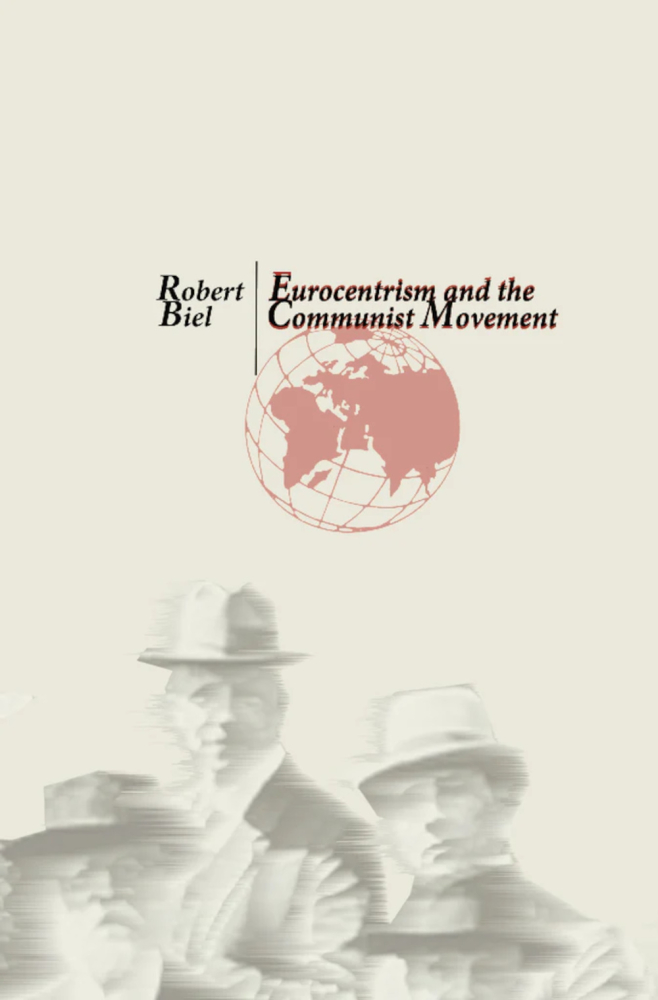
Eurocentrism and the Communist Movement
Robert Biel's Eurocentrism and the Communist Movement traces the history of Eurocentric -- and anti-Eurocentric -- currents in the Marxist-Leninist tradition, arguing that this distortion was key to the development and spread of revisionism, and ultimately to the failures of the communist project, in the 20th century.
A work of intellectual history, Eurocentrism and the Communist Movement explores the relationship between Eurocentrism, alienation, and racism, while tracing the different ideas about imperialism, colonialism, "progress", and non-European peoples as they were grappled with by revolutionaries in both the colonized and colonizing nations. Teasing out racist errors and anti-racist insights within this history, Biel reveals a century-long struggle to assert the centrality of the most exploited within the struggle against capitalism.
The roles of key figures in the Marxist-Leninist canon -- Marx, Engels, Lenin, Stalin, Mao -- within this struggle are explored, as are those of others whose work may be less familiar to some readers, such as Sultan Galiev, Lamine Senghor, Lin Biao, R.P. Dutt, Samir Amin, and others.
Eurocentrism and the Communist Movement was written in the context of the declining British Maoist movement of the late 1980s. As Robert Biel explains in his preface to this new edition:
"The work responded to a strong sense that the important task was to construct a Marxist theory of political economy which could reflect the real relationships in the contemporary world system. That was the constructive task but, before we could attempt it, we also had to conduct a negative task -- one of demolition: to identify and remove the blockage that stood in our way. This blockage was the thing we identified as Eurocentrism, a trend which imprisoned theory in an economistic and mechanical framework, denying the real dynamics of history in which the world outside the major European powers has always played such a major role, and does so still in the form of the liberation movements against all forms of oppression and neo-colonialism."
Robert Biel's Eurocentrism and the Communist Movement traces the history of Eurocentric -- and anti-Eurocentric -- currents in the Marxist-Leninist tradition, arguing that this distortion was key to the development and spread of revisionism, and ultimately to the failures of the communist project, in the 20th century.
A work of intellectual history, Eurocentrism and the Communist Movement explores the relationship between Eurocentrism, alienation, and racism, while tracing the different ideas about imperialism, colonialism, "progress", and non-European peoples as they were grappled with by revolutionaries in both the colonized and colonizing nations. Teasing out racist errors and anti-racist insights within this history, Biel reveals a century-long struggle to assert the centrality of the most exploited within the struggle against capitalism.
The roles of key figures in the Marxist-Leninist canon -- Marx, Engels, Lenin, Stalin, Mao -- within this struggle are explored, as are those of others whose work may be less familiar to some readers, such as Sultan Galiev, Lamine Senghor, Lin Biao, R.P. Dutt, Samir Amin, and others.
Eurocentrism and the Communist Movement was written in the context of the declining British Maoist movement of the late 1980s. As Robert Biel explains in his preface to this new edition,
"The work responded to a strong sense that the important task was to construct a Marxist theory of political economy which could reflect the real relationships in the contemporary world system. That was the constructive task but, before we could attempt it, we also had to conduct a negative task -- one of demolition: to identify and remove the blockage that stood in our way. This blockage was the thing we identified as Eurocentrism, a trend which imprisoned theory in an economistic and mechanical framework, denying the real dynamics of history in which the world outside the major European powers has always played such a major role, and does so still in the form of the liberation movements against all forms of oppression and neo-colonialism.
You May Also Like
Critique of the Gotha Program
Marx's fullest elaboration of his vision for a communist future, free from the shackles of capital, but also the state.
Eclipse and Re-emergence of the Communist Movement
Doing away with wage-labor, class, the State, and private property is possible, and can only be achieved by a historical break, it will not be a peaceful, gradual, piecemeal evolution.
For a Libertarian Communism
Guérin not only provides a critique of the socialist and communist parties of his day, he analyzes some of the most fundamental and pressing questions with which all radicals must engage.
Libertarian Socialism: Politics in Black and Red
This collection reveals the enduring sores in the revolutionary socialist movement in order to explore the often neglected left-libertarian currents that have thrived there.
The Workers’ Way to Freedom and Other Council Communist Writings
Pannekoek’s council communist ideas encourage individual thought rather than submission to dead-end traditions.
Strike One to Educate One Hundred: The Rise of the Red Brigades 1960s-1970s
Practical details of the BR’s innovative politics are a backbone of this book, especially its distinctive fighting style and their tactics of anti-capitalism.