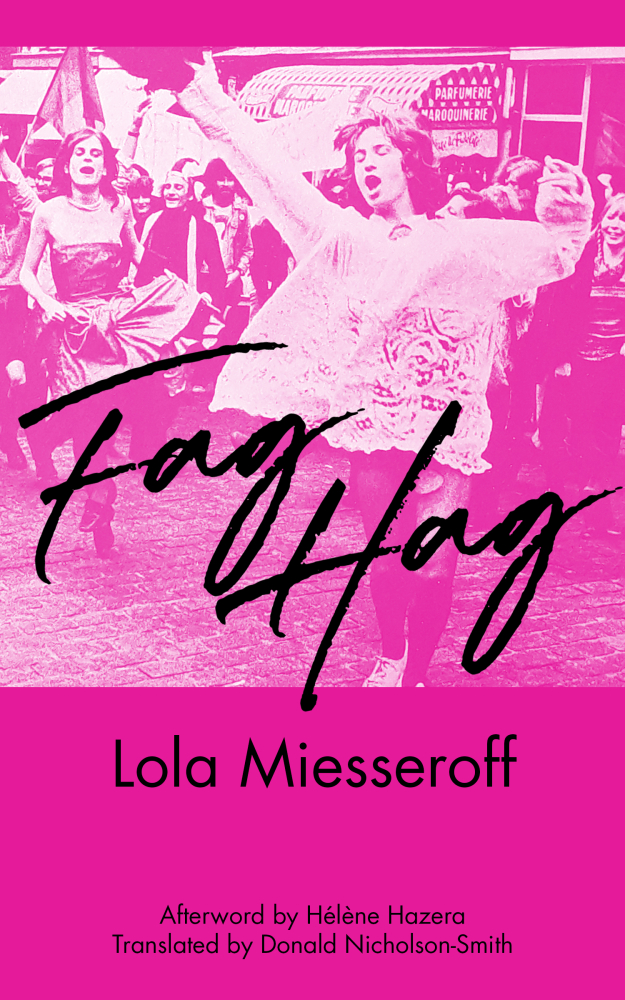
Fag Hag
Please select all options before adding to cart.
“Some girls love sailors, some love soldiers, but you, my dear, are a real fag hag!”
Lola Miesseroff’s childhood certainly predisposed her to be a rebel. She was born in 1947 to immigrant parents, and the family ran and lived in a nudist colony, a place where the men were allowed to be feminine, the women masculine. Hers was what she calls a “degendered” childhood.
Lola’s picaresque memoir Fag Hag tracks her peregrinations through what she calls the “outer left” from Marseille to Avignon and Paris—always deeply committed and involved in women’s liberation, sexual liberation, and LBGTQ liberation yet always on the fringe of formal organizations. This outer left embraced with enthusiasm experimentation with polysexuality, living communally, and organizing public demonstrations.
“I have dredged my memory,” Lola writes, “in the hope that revisiting the past might help illuminate our present; if it doesn’t, I shall have failed. I want to contribute in some small measure to the struggles of today by exposing the strengths and weaknesses of the struggles of the past, and to contest fragmented identity politics in favor of ‘all for one and one for all.’”
Praise
“A breath of fresh air in a time when inquisitorial constraints seem to have the whip hand whichever way we turn…. Lola writes in the first person with a simplicity that makes you feel good.… Her message is healthy, invigorating—may it free us from the ambient Jesuitism.”
—Jean-Claude Leroy, Mediapart
“Lola lives revolt: anarchism, Situationist International, libertarian communism, ‘outer left’… action committees, Women’s Liberation Movement (MLF), Homosexual Revolutionary Action Front (FHAR), Gouines Rouges (Red Dykes), Les Gazolines…. Communal apartments, scandals, doing drugs (joints and acid—but no needles), dérives, living from odd jobs and expedients, drinking, making love/fucking (where was the dividing line?), networking, traveling to find friends and comrades (but no hippy trail to Kathmandu—that would be a copout), and ever ready for action but never lapsing into militantism (‘the highest stage of alienation’).”
—Gilles Dauvé, author of Your Place or Mine? A 21st Century Essay on (Same) Sex
“Now that everything is commercialized and our liberated zones have shriveled, this book of Lola’s is a precious collection of recipes for freedom, a fine guide to combining political activism with personal liberation.”
—Hélène Hazera, from the afterword
About the Contributors
Lola Miesseroff was born in 1947 in Marseille. Coming of age during the wildness of May 1968, her life has been a trip through experiments in communal living, free love, radical feminism, and oppositional communism. She is the author of Voyage en outre-gauche (Voyage through the outer left), collected memories of veterans of the May ’68 movement, and, more recently, of Davaï!, a genealogical account of her ever-rebellious antecedents.
Born in Manchester, England, Donald Nicholson-Smith is a New Yorker by adoption. A sometime Situationist (1965–67), he has translated many writings of the Situationist International. PM Press has also published his translation of Veneigem's Revolution of Everyday Life as well as that of Anselm Jappe’s magisterial intellectual biography of Guy Debord. Otherwise, he has Englished works by Henri Lefebvre, Apollinaire, Artaud, and others, and he is responsible for bringing the noir fiction of Jean-Patrick Manchette into the Anglosphere.
Hélène Hazera is a trans woman who was a leading light in the Homosexual Front for Revolutionary Action (FHAR), founded in 1971, and in the more radical spinoff group Les Gazolines (1972–74). She has acted in and directed films and worked as a television and later a music critic for the daily Libération (1978–99). For many years subsequently, as a passionate lover of Francophone and Arabic-Andalusian music, she deejayed regular shows on France Culture radio.
You May Also Like
Anarchy and the Sex Question: Essays on Women and Emancipation, 1896-1926
"The Sex Question" emerged for Goldman in multiple contexts as varied as women's suffrage, "free love," birth control, the "New Woman," homosexuality, marriage, love, and literature.
Queercore: How to Punk a Revolution: An Oral History
Surviving the Future: Abolitionist Queer Strategies

The Beatrix Gates
A colorful mix of science fiction, magic realism, memoir, and myth exploring themes of spirituality and transformation. Courage and cowardice contend in a literary odyssey unlike any other.
The Revolution of Everyday Life
This treatise offers a lyrical and aphoristic critique of the "society of the spectacle" from the point of view of individual experience.
Y'all Means All: The Emerging Voices Queering Appalachia
This book demonstrates above all else that Appalachia and its people are filled with a vitality and passion for their region which will slowly but surely effect long-lasting and positive changes in the region.

Your Place or Mine? A 21st Century Essay on (Same) Sex
The utopian vision of Your Place or Mine? is vital to a just society: the invention of a world where one can be human without having to be classified by sexual practices or gender expressions.
Recently Viewed
Braided Lives
Marge Piercy turns her considerable skill and passion to the Fifties in this portrait of women in transition from repression to freedom. This new edition features a new introduction by the author.